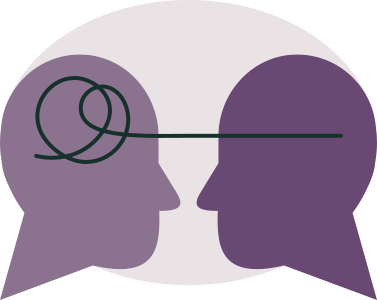
Multilingual aphasia
Aphasia in a multilingual person poses particular challenges for care. Each language can be affected differently, and languages may recover at different rates.
This part of my clinical and academic work is grounded in a perspective that values linguistic and cultural diversity. It aims to offer assessment and intervention approaches that are better suited to multilingual people living with aphasia, drawing on the available evidence.
A practical tool

This knowledge translation tool was developed by Floriane Birraud, a speech-language pathology student at the Université de Rennes, as part of her master’s thesis under my supervision.
It includes a 55-minute video and a companion booklet, both in French. The video is interactive: you can jump straight to each section using the menu here.
This material is designed as a living tool that will be updated regularly. We are sharing it in its current form to meet an important need for information now, while we continue to improve it.
English version in preparation
Video
You can also watch the video at your own pace, with subtitles, on Canva.
Information booklet
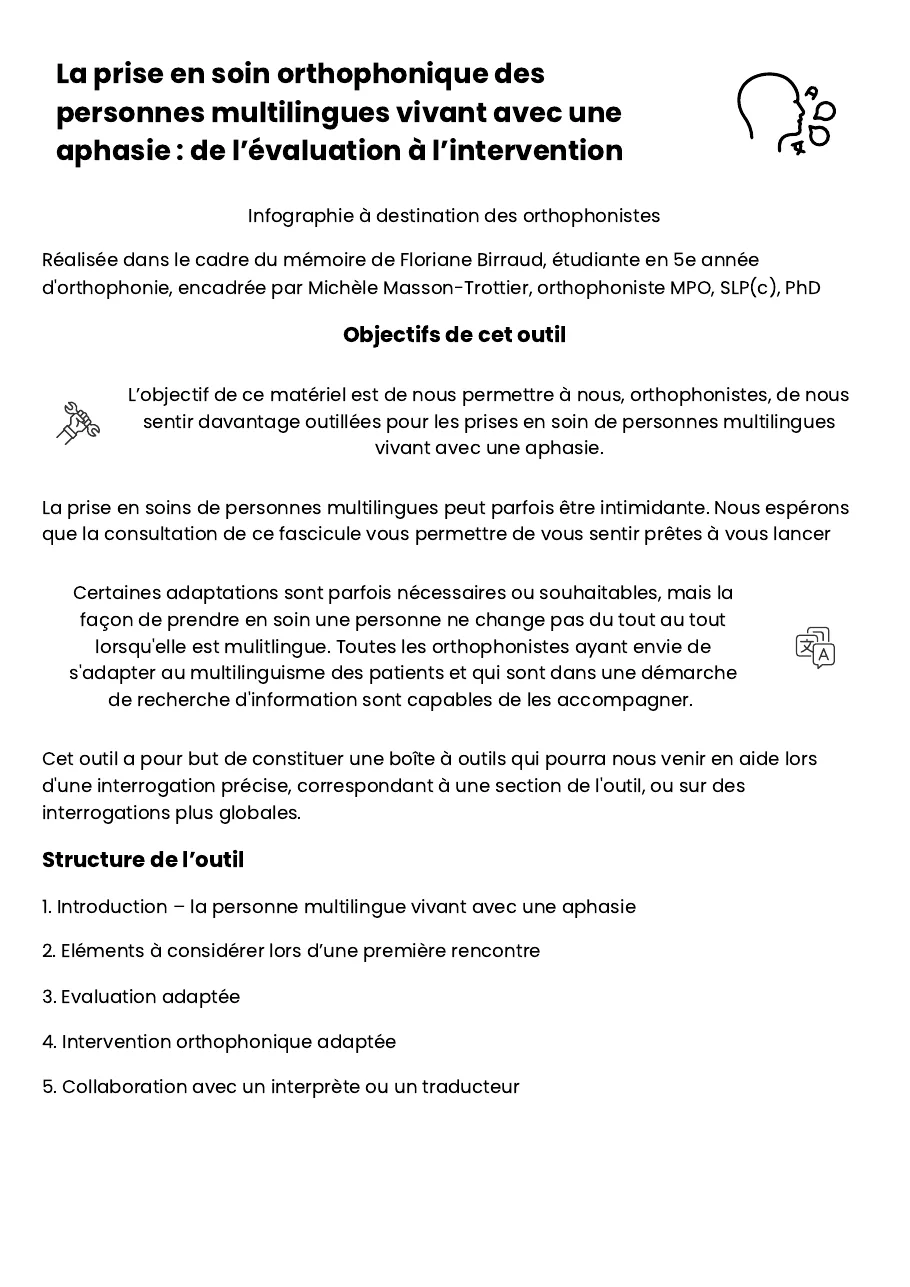
La prise en soin orthophonique des personnes multilingues vivant avec une aphasie : de l’évaluation à l’intervention
Speech-language pathology care for multilingual people living with aphasia: from assessment to intervention
Browse it here
Tools to support care for multilingual people
Assessment tools
Bilingual Aphasia Test (BAT)
available online
Amharic | Algerian Arabic | Arabic (Modern Standard) | Armenian (Eastern) | Armenian (Western) | Azeri | Baluchi | Basque | Bengali | Berber | Bosnian | Brazilian Portuguese | Bulgarian | Cantonese | Carinthian | Castilian | Catalan | Croatian | Czech | Danish | Dholuo | Dutch | English | Farsi | Finnish | French (European) | French (Quebec) | Friulian | Galician | German | Gilaki | Greek | Hebrew | Hindi | Hungarian | Icelandic | Inuktitut | Italian | Japanese | Jordanian Arabic | Kannada | Korean | Kurdish | Latvian | Lithuanian | Luganda | Luri | Malagasy | Malay | Mandarin | Mazandarani (Eastern) | Norwegian | Oriya | Palestinian Arabic | Polish | Portuguese (European) | Romanian | Russian | Sardinian | Serbian | Shona | Slovenian | Somali | Spanish (American) | Swahili | Swedish | Tagalog | Talysh | Tamil | Tulu | Tunisian Arabic | Turkish | Ukrainian | Urdu | Vietnamese | Yiddish
Tradaphasia
available online
Albanian | German | Alsatian | English (UK) | English (US) | Algerian Arabic | Egyptian Arabic | Iraqi Arabic | Lebanese Arabic | Moroccan Arabic | Syrian Arabic | Tunisian Arabic | Argentinian (Córdoba) | Western Armenian | Eastern Armenian | Aymara | Bambara | Basque | Brazilian Portuguese | Breton | Bulgarian | Cantonese | Chilean Spanish | Mandarin Chinese | Korean | Haitian Creole | Mauritian Creole | Réunion Creole | Dagara | Dari | Spanish | Venezuelan Spanish | Farsi | Finnish | Fon | Garhwali | Greek | Gujarati | Hebrew | Hindi | Hungarian | Italian | Japanese | Kabyle | Kalenjin | Khmer | Iraqi Kurdish (Sorani) | Luxembourgish | Macedonian | Malagasy | Mina | Dutch | Pashto | Fula | Polish | Portuguese | Quechua | Romanian | Russian | Serbian | Slovak | Swedish | Tagalog | Tamil | Thai | Tibetan | Turkish | Twi | Ukrainian | Northern Vietnamese | Southern Vietnamese
Chapel Hill Multilingual Intelligibility Test (CHMIT)
available online
An intelligibility test using single-syllable words, available in English | Arabic | Danish | Estonian | Finnish | French | German | Greek | Hindi | Japanese | Korean | Russian | Spanish | Swedish
Boston Diagnostic Aphasia Examination (BDAE)
more information
English | Spanish | Portuguese | French | Hindi | Finnish | Greek
Comprehensive Aphasia Test (CAT)
more information
English | Catalan | Croatian | Dutch | French | Hungarian | Norwegian | Spanish | Turkish
In development:
Arabic (Moroccan) | Basque | Cantonese | German | Greek | Icelandic | Lithuanian | Serbian | Slovenian | Swedish
Language profiling tools
LEAP-Q questionnaire
available online
German | English | Arabic | Catalan | Spanish | Farsi/Persian | Finnish | French | Gaelic | Welsh | Greek | Hebrew | Hindi | Hungarian | Indonesian | Irish | Italian | Japanese | Kannada | Kinyarwanda | Korean | Latvian | Malay | Malayalam | Mandarin | Marathi | Dutch | Nepali | Northern Sami | Norwegian | Urdu | Polish | Portuguese | Romanian | Russian | Serbian | Slovenian | Swedish | Tagalog/Filipino | Tamil | Czech | Thai | Turkish | Vietnamese
Bilingual Language Profile (BLP)
available online
Languages are listed on the website.
Available in paper-and-pencil or digital format.
Intervention tools
Tactus Therapy
available online
Therapy apps for tablets (iPad and Android). The Comprehension Therapy, Naming Therapy, Reading Therapy and Writing Therapy apps are available in English | Spanish | French | German
AbSANT therapy
available online
Abstract Semantic Associative Network Training has been studied in bilingual individuals, and the materials are available on request.
Sympatico Group – Resources
view online
This page offers resources to support culturally responsive practice with people living with aphasia.
Other resources
Aphasia Therapy Finder
view online
Aphasia Therapy Finder is a searchable database of evidence-based aphasia therapies. You need to create an account to use it – it’s free. It offers easy access to therapy descriptions, evidence summaries and resources for quickly putting evidence-based therapies into clinical practice.
Note: the therapies are not necessarily multilingual; most are in English.
Multilingual Topics in Communication Sciences & Disorders (MultiCSD)
view online
A website with information about the structure of different languages and different cultures, along with advice and clinical examples.
AI assistant for assessing and managing multilingual aphasia 🤖
view online
This GPT is a specialized assistant designed to support speech-language pathologists working with multilingual people living with aphasia, particularly after a stroke. It draws on a carefully selected knowledge base of more than 80 scientific publications, case studies and clinical guidelines to provide evidence-based answers.