Clinical speech-language pathology
Please note that I am not taking on new clients until further notice.

Photo by Jakub Żerdzicki on Unsplash
My services
My philosophy
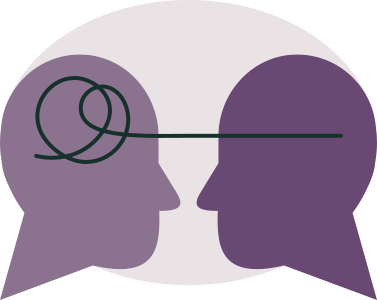
As a speech-language pathologist who follows the Life Participation Approach to Aphasia, my goal is to provide interventions that lead to functional outcomes and reduce the disability that communication difficulties can create.
My approach aims to help you resume or improve the communication activities that matter to you, whatever they are. Whether you want to hold a conversation, follow a news report, read an article, write an email or speak more loudly, the intervention plan we build together starts from your goals and your plans.
I consider communication in its social context and base my interventions on theoretical frameworks from neuroscience and the psychology of learning. Whenever possible and appropriate, I work collaboratively with the person living with the communication difficulty and with the people around them.
I offer individual or dyadic sessions in private practice (see conditions below). For many years I worked as a speech-language pathologist with the Association québécoise des personnes aphasiques (AQPA) through the SAPPA project (services for families of people with aphasia), providing dyadic interventions and support groups for people living with post-stroke aphasia or primary progressive aphasia and their families.
Signs it may be time to consult
It may be helpful to see a speech-language pathologist if you or someone close to you:
- has difficulty communicating with a family member
- finds it hard to take part in group conversations
- searches for words
- loses track of conversations
- does not understand what they read
- cannot take notes
- has difficulty writing a message
- has difficulty articulating
- has a weak, overly loud or hoarse voice
- has difficulty swallowing
Who I work with
I work with people who have communication difficulties from a range of causes:
- Aphasia after a stroke or a traumatic brain injury
- Primary progressive aphasia or another neurocognitive disorder (Alzheimer’s disease, Parkinson’s disease, multiple sclerosis)
- Apraxia of speech
- Dysarthria
- Dysphagia
- Dysphonia and other voice disorders
- Cognitive-communication disorders
How services are delivered
All sessions take place either at home or by telepractice. For home visits, a travel fee of $40 applies for central Montreal Island (west of Décarie, north of the Métropolitain, east of Papineau and south of Notre-Dame), and $60 for previously agreed travel within Greater Montreal. All fees are in Canadian dollars and are subject to change.